
The Wise Nest Rule of 15
15 behaviors.
Every leader needs all of them.
The Rule of 15 is a complete behavioral leadership framework — organized in three tiers, taken in order, each one building on the one before it. Interpersonal first. Relational second. Growth third. In that order, for a reason.
A framework built in sequence
Three tiers. Each one requires the one before it.
Most leadership programs teach behaviors as a list. The Rule of 15 teaches them as a sequence. Tier 1, Interpersonal, is where every leader starts — how you communicate in the moment. Without it, nothing that follows holds. Tier 2, Relational, builds on it — how you keep commitments over time. Tier 3, Growth, builds on both — how you improve and lift others with you. You cannot shortcut the sequence. That is the point.
Tier 1 — Where It Starts
Interpersonal — “How I communicate”
These five behaviors govern how information flows between people. Listening, speaking clearly, showing respect, being honest, keeping it real. A person who cannot listen cannot build a relationship. A person who cannot speak clearly cannot lead anyone. These are not soft skills. Everything that follows depends on them.
Listen First, Speak Last
Attentiveness · Empathy · Open-mindedness · Understanding · Calmness
Speak Clearly
Clarity · Honesty · Directness · Simplicity · Articulacy
Model Respect
Respect · Kindness · Courtesy · Empathy · Humility
Be Transparent
Candor · Honesty · Trustworthiness · Integrity · Credibility
Keep It Real
Realism · Truth · Honesty · Awareness · Courage
Tier 2 — Built on Tier 1
Relational — “How I connect and commit”
Built on communication. These five behaviors are about how commitments are kept over time — setting expectations, building trust, staying loyal, following through, and owning your actions. Relationships are built conversation by conversation, promise by promise. You can only do this well if the Interpersonal behaviors are already in place.
Set Clear Expectations
Clarity · Directness · Articulacy · Expectancy · Direction
Model Smart Trust
Trust · Growth · Learning · Cooperation · Reliability
Model Loyalty
Loyalty · Family · Support · Strength · Solidarity
Follow Through on Commitments
Commitment · Reliability · Honor · Perseverance · Discipline
Model Accountability
Integrity · Fairness · Courage · Learning · Humility
Tier 3 — Built on Tiers 1 and 2
Growth — “How I improve and lead others”
Built on relationships. These five behaviors are about how individuals get better and lift others with them — doing what’s right, improving constantly, delivering results, mentoring those who are different, and adapting when life changes. Growth without integrity is just ambition. Growth without relationships is just self-improvement.
Do the Right Thing
Integrity · Gratitude · Courage · Justice · Honesty
Continuously Improve
Growth · Perseverance · Learning · Excellence · Discipline
Produce Results
Achievement · Drive · Efficiency · Perseverance · Resourcefulness
Mentor Diversity
Diversity · Open-mindedness · Learning · Curiosity · Acceptance
Be Adaptable
Adaptability · Flexibility · Resilience · Resourcefulness · Willingness
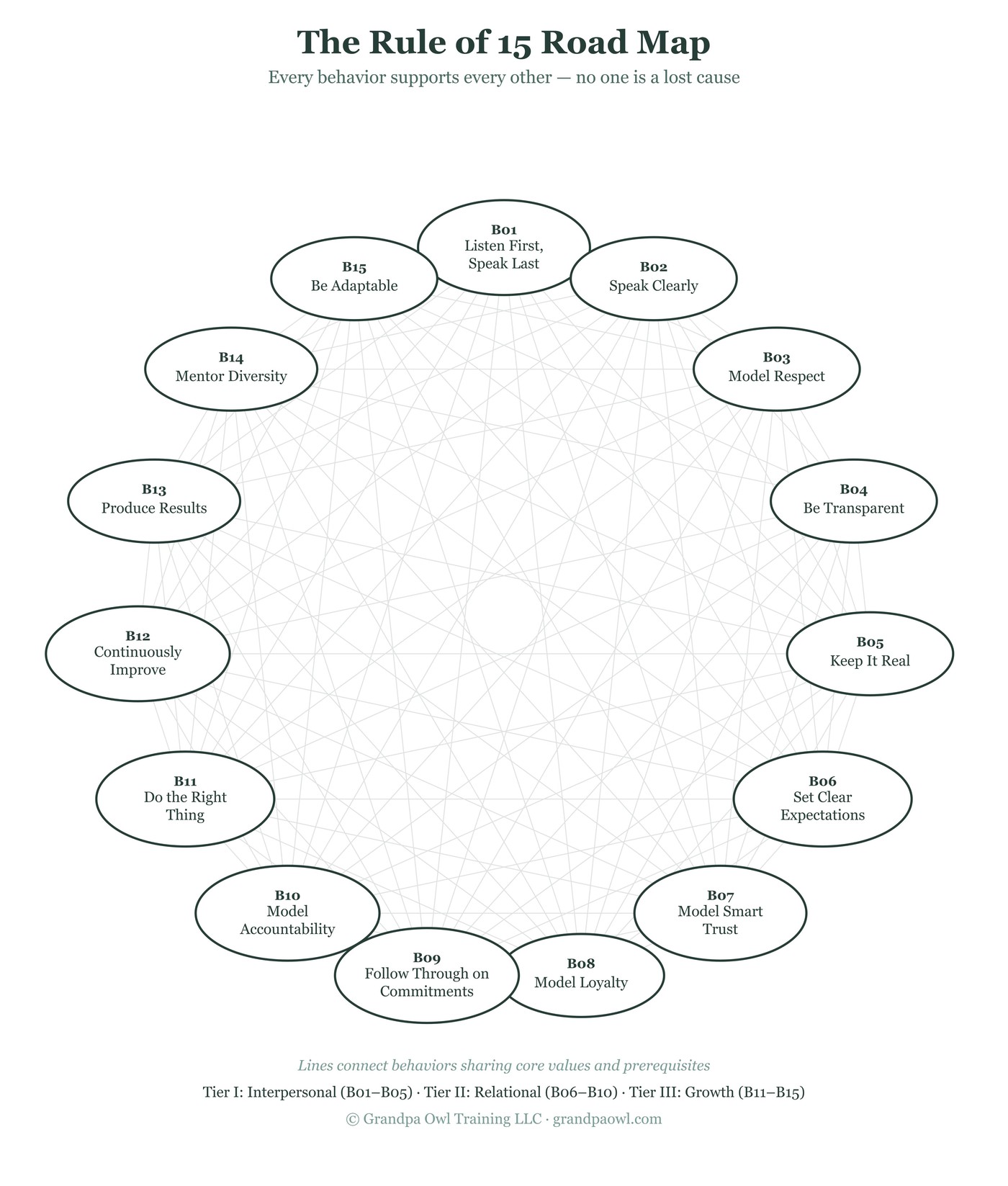
Everything connects to everything
The Rule of 15 Road Map
Every one of the 15 behaviors strengthens every other one. Being adaptable makes you a better listener. Following through on commitments builds the trust that makes clear communication land. Doing the right thing creates the safety that turns relational behaviors into cultural norms. The Road Map makes this visible — 102 connections showing why no behavior is developed in isolation, and why the sequence of the three tiers is not arbitrary.
How the Rule of 15 is taught
One rule per week. Five Core Values per rule. One prerequisite skill at a time.
Most leadership programs tell people what to do. The Rule of 15 builds the behaviors from the inside out — starting with the prerequisite skills that make each behavior achievable, moving through the Core Values that define it, and closing with an Identity Statement that anchors it in who the leader is becoming.
The Rule
One behavioral standard per week — the same rule for every age, from 6 through teen and the adults in the home.
Five Core Values
Each rule has five Core Values — one per day. 75 Core Values across the full program.
Prerequisite Skills
Every Core Value is built on prerequisite skills — the foundational abilities that make the value teachable at any age.
Identity Closing
Every Friday Capstone ends with an Identity Statement — spoken aloud, first person, behavioral. “I am the kind of person who…”
Every person practices the same 15 rules
The path to each behavior is different for each leader.
The Wise Nest Temperament Discovery Guide helps parents identify each child’s natural leadership wiring — using personality type principles to understand how each child learns, commits, connects, and grows. Four natural wiring types. The same 15 behaviors. A different coaching approach for each.
15 guided activities. No formal assessment required. Works alongside the Family Playbook from Week One.
Ready to begin?
The kitchen table is waiting.
The Wise Nest Family Playbook delivers the Rule of 15 one week at a time — built for every age in your home, guided by you. Start with a free week, or join the 200 families shaping the final Playbook.